


























Live News
Over 9,000 Ebola cases recorded in Congo
City deserve to keep titles even if guilty of financial breaches — Enrique
Tinubu names opposition governors in 2027 re-election campaign council
United can weather the storm after worst start in 40 years — Carrick
Report: Nigeria’s Multidimensional Poverty Rises to 38.7% Under Tinubu
“The lecture hall was full, but something was missing.”
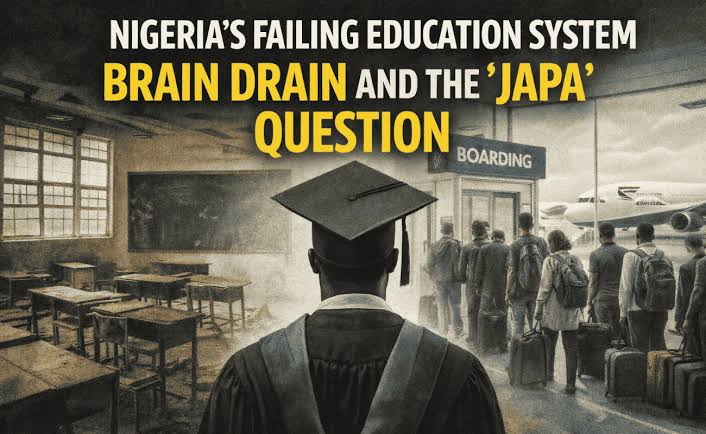
When Professor Ibrahim (not his real name) walked into his engineering class at a Nigerian federal university earlier this year, he found more than 300 students crammed into a lecture theatre designed for barely 120.
The laboratory equipment required for practical sessions had not been replaced in years, internet access was unreliable and several offices once occupied by senior academics now stood empty.
Some colleagues had accepted positions in the United Kingdom, Canada and the Middle East. Others were completing applications to leave. Looking around the campus, he quietly remarked, “We’re no longer just teaching students. We’re trying to keep the university alive.”
His observation reflects a crisis unfolding across much of Africa. Universities that once produced generations of scientists, engineers, doctors and public leaders are increasingly struggling to fulfil that mission.
While student enrolment continues to grow at an unprecedented rate, funding has failed to keep pace, research capacity is weakening and experienced academics are leaving in record numbers. The result is a higher education system under immense pressure at precisely the moment when knowledge, innovation and research have become the world’s most valuable economic assets.
According to UNESCO’s first Higher Education Global Trends Report (2026), global higher education enrolment reached 269 million students in 2024, more than double the figure recorded two decades earlier. International student mobility has also expanded dramatically, with 7.3 million students pursuing education outside their home countries.
Yet beneath these encouraging global trends lies a widening inequality. UNESCO notes that sub-Saharan Africa continues to lag behind other regions in access to higher education, research funding, academic infrastructure and institutional capacity. While the global knowledge economy accelerates, many African universities are struggling simply to keep their classrooms open and their best lecturers employed.
Nigeria has long celebrated the global success of its professionals. Nigerian doctors work in hospitals across Europe and North America. Nigerian engineers contribute to major infrastructure projects worldwide. Nigerian academics teach and conduct research at some of the world’s leading universities.
What receives far less attention is the impact this migration has on the institutions they leave behind.
Every experienced lecturer who resigns creates a gap that cannot easily be filled. Student-to-staff ratios increase, postgraduate supervision declines, research output weakens and younger academics lose valuable mentors. The departure of one professor rarely affects one classroom alone. It weakens an entire department, slows research collaboration and reduces the university’s capacity to attract grants and international partnerships.
The popular narrative often describes brain drain as an individual career decision.
Increasingly, it has become a national development challenge.
Perhaps the greatest contradiction facing African higher education is that governments expect universities to compete globally while funding them locally.
Across the continent, universities are enrolling record numbers of students while operating with ageing infrastructure, overcrowded lecture halls, outdated laboratories and limited research funding. Libraries struggle to maintain current academic resources, digital infrastructure remains uneven and operational costs continue rising.
The pressure is becoming even greater. According to UNESCO’s Global Education Monitoring Report (2025), international aid to education declined sharply during 2024 and is projected to fall by more than 25 percent by 2027, reducing an important source of support for countries already facing significant financing challenges. As development assistance contracts, governments will increasingly need to rely on domestic investment if universities are to remain competitive.
Nigeria reflects many of these pressures. Although successive governments have introduced initiatives such as student loan schemes, scholarships and education reforms, universities continue to struggle with deteriorating infrastructure, limited research funding and rising operational costs. Repeated industrial disputes have disrupted academic calendars for years, while underfunding has steadily reduced the global competitiveness of many institutions.
Universities do far more than award degrees.
They develop vaccines.
Design technologies.
Improve agricultural productivity.
Shape public policy.
Train future entrepreneurs.
Drive industrial innovation.
When experienced researchers leave, countries lose far more than lecturers. They lose intellectual capital capable of solving national problems.
The UNESCO Institute for Statistics’ 2026 Research and Development Data Release emphasises that investment in research institutions and qualified researchers remains one of the strongest indicators of long-term economic competitiveness.
Countries leading today’s global economy did not become innovation hubs by accident. They invested consistently in universities, research centres and scientific talent over decades.
Nigeria frequently speaks about becoming a digital economy and a manufacturing hub.
Those ambitions become difficult to achieve if the country’s research ecosystem continues losing many of its most experienced academics.
Financial pressure on universities is becoming a global phenomenon.
Across Europe, North America and parts of Asia, higher education institutions are adapting to changing economic realities. In the United Kingdom, declining international student enrolment has significantly affected university finances. According to Universities UK, a 2026 sector-wide survey found that many institutions have responded by reducing research expenditure, restructuring academic programmes and implementing staff reductions.
The difference, however, is one of resilience.
Universities in wealthier countries often possess diversified funding sources, large endowments, strong alumni networks and significant private-sector partnerships that help cushion financial shocks. Many African universities do not enjoy those advantages.
Artificial intelligence, virtual laboratories, online learning platforms and digital libraries are transforming universities around the world. These technologies offer exciting possibilities for expanding access, improving teaching quality and encouraging international collaboration.
Yet technology alone cannot rescue struggling universities.
Digital transformation depends on reliable electricity, affordable broadband, modern infrastructure and sustained investment in academic capacity. Without those foundations, technology risks widening existing inequalities between well-funded institutions and those already struggling with limited resources.
Technology is an enabler.
It is not a substitute for investment.
The Future of Universities Depends on Political Choices
If Nigeria is serious about becoming a knowledge-driven economy, universities must no longer be viewed primarily as recurrent budget obligations.
They are strategic national investments.
Governments need to increase research funding, strengthen university governance, improve institutional autonomy and create policies that encourage members of the academic diaspora to contribute through collaborative teaching, research partnerships and innovation programmes.
The private sector also has a critical role to play. Businesses that rely on highly skilled graduates have a direct interest in supporting university research, innovation hubs, scholarships and modern infrastructure. Around the world, leading universities thrive because governments, industry and philanthropy invest together.
Equally important is creating working environments that encourage talented academics to remain in Nigeria. Competitive salaries, modern laboratories, transparent promotion systems, research grants and opportunities for international collaboration are no longer luxuries.
They are necessities.
Every country that has achieved sustained economic transformation has invested heavily in higher education.
South Korea did it.
Singapore did it.
China did it.
The world’s leading economies understood that universities are not simply places where degrees are awarded.
They are where ideas are created.
Nigeria now faces a defining choice.
It can continue celebrating the global success of academics who leave while underinvesting in the institutions that trained them.
Or it can recognise that universities are not ordinary public institutions.
They are national assets whose greatest value lies not in the number of graduates they produce but in the discoveries, innovations and solutions they generate.
Because when a country loses its best scholars, it loses more than lecturers.
It risks losing the ideas that would have built its future.