





























Live News
Over 9,000 Ebola cases recorded in Congo
City deserve to keep titles even if guilty of financial breaches — Enrique
Tinubu names opposition governors in 2027 re-election campaign council
United can weather the storm after worst start in 40 years — Carrick
Report: Nigeria’s Multidimensional Poverty Rises to 38.7% Under Tinubu
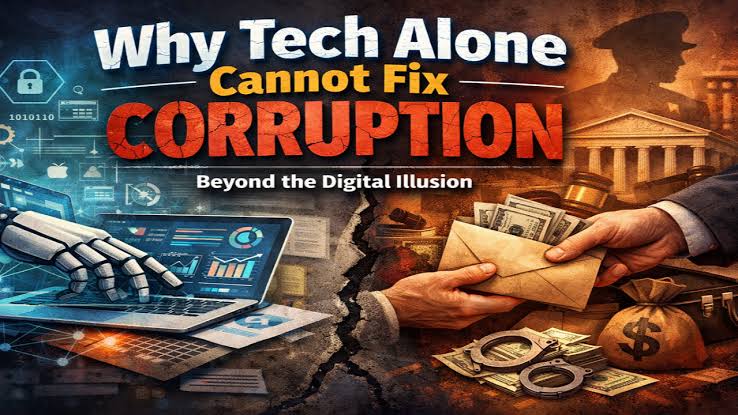
For decades, governments have promised to defeat corruption with tougher laws, stronger institutions and more arrests. Yet corruption continues to evolve. Today, a new promise has emerged: technology will succeed where politics has failed. But can digital governance truly dismantle corruption, or is it simply giving an old problem a modern interface?
Around the world, governments are investing billions of dollars in digital transformation, believing that technology can reduce human discretion, strengthen transparency and close the loopholes through which public funds disappear.
From electronic procurement systems and biometric identity databases to online tax payments and digital business registration, the theory is compelling. The fewer face-to-face interactions citizens have with public officials, the fewer opportunities exist for bribery, document manipulation and abuse of office. Yet experience across the world suggests that technology alone cannot eliminate corruption. In some cases, it merely changes the way corruption operates.
The urgency of finding new solutions has never been greater. According to Transparency International’s 2024 Corruption Perceptions Index, corruption continues to undermine economic growth, weaken democratic institutions and discourage investment across much of the developing world. The report argues that countries with stronger public institutions and greater transparency consistently perform better in controlling corruption. Increasingly, digital governance has become part of that conversation—not as a silver bullet, but as a potentially powerful weapon.
Nigeria has embraced digital reforms more aggressively than many people realise. Over the past decade, government agencies have quietly transformed several public services that were once notorious for bureaucracy and administrative delays.
The Corporate Affairs Commission (CAC) now allows entrepreneurs to complete most company registrations online. The Federal Inland Revenue Service (FIRS) has expanded electronic tax filing and payment systems, while the Nigeria Customs Service continues to automate customs operations to reduce revenue leakages and improve efficiency.
Equally significant, the introduction of the Treasury Single Account (TSA) and the Government Integrated Financial Management Information System (GIFMIS) has strengthened oversight of public finances by reducing fragmented government accounts and improving expenditure monitoring.
These reforms are not merely administrative conveniences. According to the World Bank’s 2025 Nigeria Development Update, improvements in digital revenue collection and public financial management have contributed to stronger fiscal performance and increased government revenues.
The report, however, also delivers an important warning: technology can improve transparency, but sustainable progress ultimately depends on stronger institutions, consistent governance and political accountability.
One of digital governance’s greatest strengths is its ability to create permanent records.
Traditional cash transactions often leave little evidence, making bribery, payroll fraud and unofficial payments difficult to detect. Digital payment systems, by contrast, generate electronic audit trails that make financial transactions easier to monitor and investigate.
Across Nigeria, salaries, taxes, licence fees and other government payments are increasingly processed electronically, reducing opportunities for ghost workers, revenue diversion and unofficial charges that once flourished within manual systems.
Public procurement offers another example of technology’s transformative potential. According to the Organisation for Economic Co-operation and Development (OECD), procurement remains one of the sectors most vulnerable to corruption because governments spend enormous amounts awarding contracts for roads, hospitals, schools and infrastructure.
Electronic procurement systems reduce opportunities for manipulation by publishing tenders online, standardising bidding procedures and creating digital records that make contract awards easier to scrutinise. When properly implemented, these systems increase competition while making it more difficult to conceal financial irregularities.
Yet technology has its limits.
Corruption is remarkably adaptable. When opportunities disappear in one area, they often emerge elsewhere. A dishonest official operating a sophisticated digital platform can still manipulate procurement decisions, approve fraudulent transactions or abuse privileged system access if oversight remains weak. Technology can expose corruption more quickly, but it cannot eliminate corruption where political interference, weak institutions and poor accountability continue to thrive.
This explains why countries with advanced digital infrastructure are not automatically free from corruption. Digital governance improves systems, but integrity remains a human responsibility.
Without independent institutions capable of investigating misconduct and enforcing the law, technology risks becoming another administrative tool rather than a transformative reform.
Another challenge receives far less attention.
Digital governance assumes that citizens can actually access digital services. According to the International Telecommunication Union (ITU), although internet connectivity continues to expand globally, millions of people in developing countries remain excluded because of unreliable broadband, limited digital literacy and inadequate access to digital devices. Nigeria reflects this reality. While urban centres increasingly benefit from online government services, many rural communities continue to struggle with poor internet connectivity and limited digital infrastructure.
If governments move public services online without addressing these inequalities, digital governance could unintentionally create a new form of exclusion, leaving millions unable to access essential government services simply because they lack reliable internet access.
Digital governance introduces another challenge that previous generations never faced.
As governments collect increasing amounts of personal information through digital identity systems, tax records and online public services, cybersecurity becomes as important as transparency. Citizens must have confidence that their data will not be misused, stolen or manipulated. Building that confidence requires strong cybersecurity frameworks, effective data protection legislation and independent oversight capable of holding both public institutions and private technology providers accountable.
Without public trust, even the most sophisticated digital systems risk failure.
Several countries have demonstrated that technology can significantly strengthen governance—but only when accompanied by institutional reform.
Estonia has become one of the world’s leading digital governments, allowing citizens to access almost every public service online. Rwanda’s Irembo platform has transformed the delivery of government services while reducing administrative bottlenecks. Kenya’s eCitizen platform has similarly simplified access to dozens of public services, improving efficiency while reducing opportunities for petty corruption.
The common lesson is striking.
Technology succeeded because institutions were simultaneously strengthened.
Digital systems were introduced alongside administrative reforms, stronger accountability mechanisms and political commitment to transparency.
Nigeria already possesses many of the ingredients required to become a continental leader in digital governance. Its rapidly growing fintech industry, vibrant technology ecosystem and youthful, digitally connected population provide strong foundations for future reform. The country has also demonstrated that digital innovation can improve public financial management and service delivery when supported by effective implementation.
The greater challenge lies elsewhere.
Can institutions evolve as quickly as technology?
Can transparency become more powerful than political patronage?
Can digital systems remain independent when powerful interests seek to manipulate them?
These questions may ultimately determine whether digital governance becomes a genuine anti-corruption revolution or simply another well-intentioned reform.
The greatest misconception about technology is that it can replace leadership.
It cannot.
Technology can reduce opportunities for corruption. It can create transparent audit trails, simplify public services and expose financial irregularities more quickly than ever before. But computers cannot prosecute corruption. Software cannot replace integrity. Algorithms cannot substitute for independent institutions.
The fight against corruption has never been purely technological.
It has always been political.
Until governments demonstrate the courage to enforce accountability consistently, digital governance will remain exactly what it is: a powerful tool rather than a complete solution.
The real question, therefore, is not whether technology can defeat corruption.
It is whether governments are prepared to use technology to make corruption impossible instead of merely making it harder to hide.