















Live News
THE TINUBU TEST: WHAT HAS CHANGED SINCE 2023?
THE ATIKU QUESTION: CAN EXPERIENCE BECOME A NATIONAL COALITION?
FROM ACTIVISM TO ASO ROCK: CAN PROTEST POLITICS WIN POWER?
MOVEMENT OR MACHINERY? PETER OBI’S BIGGEST 2027 QUESTION
Two Nigerians arrested over drug trafficking in Saudi Arabia
Putin sacks Murmansk governor Chibis over corruption charges
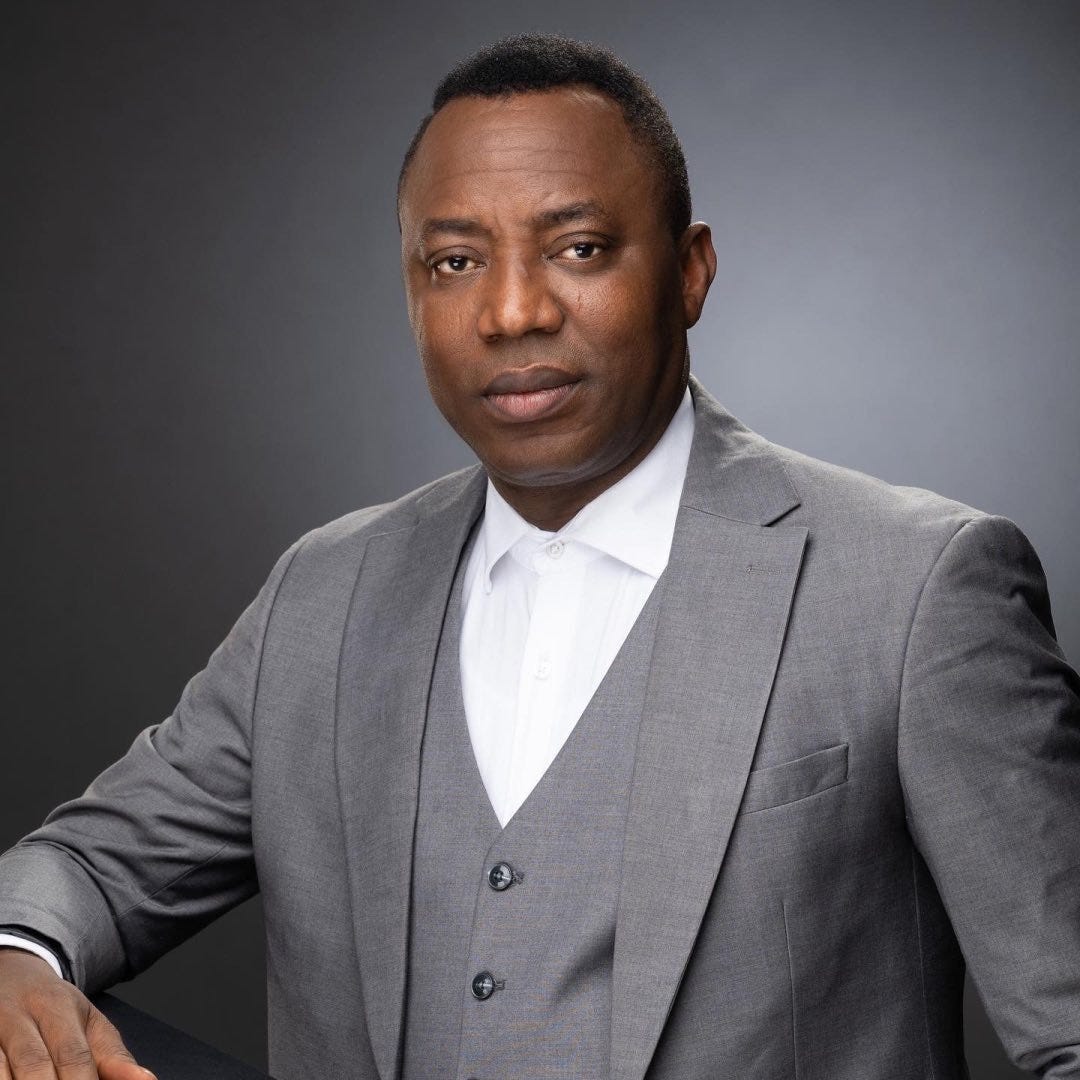
Sowore enters the 2027 presidential race as the clearest anti-establishment candidate on the ballot. He is not presenting himself as a softer version of the political class. His message is that the system itself is the problem, and changing its occupants without changing that system will not transform Nigeria.
That makes his campaign more than another presidential bid. It is a test of whether protest politics, built on confrontation, ideological clarity and rejection of elite bargains, can actually capture power in Nigeria.
Sowore, 55, is the African Action Congress candidate and founder. He contested the presidency under the AAC in 2019 and 2023 and is now running for a third time, with Haruna Garba Magashi as running mate. He emerged as the party’s 2027 candidate in 2026 and stepped down as national chairman to concentrate on the campaign.
His political identity has remained consistent: rather than promising to manage the existing order differently, he argues for a fundamental break with it.
That consistency is his asset. It is also his biggest problem.
THE POLITICS OF REFUSAL
Sowore has repeatedly rejected broader opposition arrangements. In 2026, he rejected talks aimed at producing a single opposition candidate, arguing that such arrangements amounted to elite horse-trading and recycling politicians he believes are responsible for Nigeria’s problems.
By refusing coalition politics, Sowore protects his campaign’s identity while remaining outside alliances and networks that could expand his candidacy beyond its traditional base.
The question is whether political purity can compensate for political isolation.
That tension defines his campaign: the system he wants to replace may be the system he must first master politically.
THE RADICAL PROGRAMME
Sowore’s 2027 programme is deliberately expansive. He has promised a ₦500,000 monthly living minimum wage, 24-hour electricity, free education at all levels, one million public mixed-income homes and tenancy reforms. He has also called for industrialisation, agricultural expansion, infrastructure investment, stronger healthcare and technology-driven security reforms.
The appeal is obvious in a country facing high living costs, unreliable electricity, unemployment and insecurity. Sowore frames his programme around “revolutionary justice and equal rights,” arguing that Nigeria’s resources should produce better living conditions.
But the harder question is implementation.
A manifesto is not a budget. A ₦500,000 wage commitment, universal free education, 24-hour electricity and one million homes would require enormous resources, institutional capacity and a detailed financing strategy.
Sowore and the AAC argue that resources exist but are diverted through corruption, inefficiency and elite capture. Critics can ask how quickly those resources could be recovered and converted into nationwide programmes.
That gap between political ambition and administrative execution is central to the Sowore experiment.
THE MACHINE PROBLEM
Nigerian presidential elections are fought on a scale that makes protest politics difficult.
A candidate must build structures across states, local governments, wards and polling units. Campaigns require agents, logistics, communications, legal teams, transportation, funding and election-day coordination.
Sowore has demonstrated the ability to generate attention and mobilise activists. The harder question is whether the AAC possesses the nationwide organisation required to compete against parties with established structures and far greater resources.
This is the central contradiction.
The movement is strongest when it stands outside the system. Elections, however, reward candidates who can operate inside thousands of political structures simultaneously.
A viral message cannot replace a polling agent. A rally cannot substitute for ward organisation. Anger can produce turnout, but anger alone does not guarantee coordinated voting.
Supporters may see this as evidence of a system designed to protect established parties. Critics may see it as evidence that protest has not yet become organisation.
Both interpretations belong in the 2027 debate.
THE NUMBERS PROBLEM
There is another uncomfortable fact: Sowore’s previous presidential results have remained small. INEC recorded 33,953 votes for him in 2019 and 14,608 in 2023. Those figures do not measure the size of his ideas or the intensity of his supporters, but they measure how far his movement translated into ballots nationally.
The 2027 campaign therefore begins with a credibility question: can a candidate who has remained electorally marginal build the national reach required for the presidency?
Sowore’s response is that conventional measures of political strength are products of the old system. The AAC points instead to volunteer mobilisation, small-donor politics and a campaign built around ordinary Nigerians rather than governors and political financiers.
The election will test whether that proposition can move from political theory to polling-unit reality.
THE PROTEST VOTE
Sowore occupies a difficult space in the opposition landscape.
He appeals to Nigerians who believe the major parties are variations of the same political establishment. But multiple opposition candidates mean voters dissatisfied with the government have several choices.
His refusal to join a single-candidate coalition therefore has competing interpretations.
To supporters, it represents consistency: why join politicians whose records and methods he has spent years challenging?
To critics, it represents fragmentation: another opposition candidacy competing for voters who might otherwise concentrate behind one alternative.
The arithmetic remains the same. Every independent candidacy creates another political centre of gravity.
THE SOWORE TEST
Sowore’s 2027 campaign is testing whether protest can become power without becoming the establishment it opposes.
That is the paradox.
To win Aso Rock, a protest movement must build the machinery required to enter Aso Rock. But the larger that machinery becomes, the harder it may be to maintain the outsider identity that made the movement attractive.
Sowore has spent years saying what other politicians will not. The unanswered question is whether that confrontation can translate into votes, organisation and governing authority.
The 2027 election will provide a harder test than activism ever could.
Protest can expose failure. It can mobilise anger. It can challenge powerful people.
But Nigeria’s presidency requires something more difficult: turning conviction into organisation and organisation into government.
That is the Sowore question.
Can the man who has spent years fighting the system build enough of a machine to defeat it without becoming part of the machine he has spent his political career attacking?