

























Live News
Over 9,000 Ebola cases recorded in Congo
City deserve to keep titles even if guilty of financial breaches — Enrique
Tinubu names opposition governors in 2027 re-election campaign council
United can weather the storm after worst start in 40 years — Carrick
Report: Nigeria’s Multidimensional Poverty Rises to 38.7% Under Tinubu
“Every morning, twelve-year-old Amina watches children in neatly pressed uniforms walk past her family’s roadside stall on their way to school. She does not follow them. Instead, she spends her day helping her mother sell vegetables. She dreams of becoming a doctor, but dreams alone cannot build classrooms, pay teachers or replace opportunities lost to systems that have failed her.”
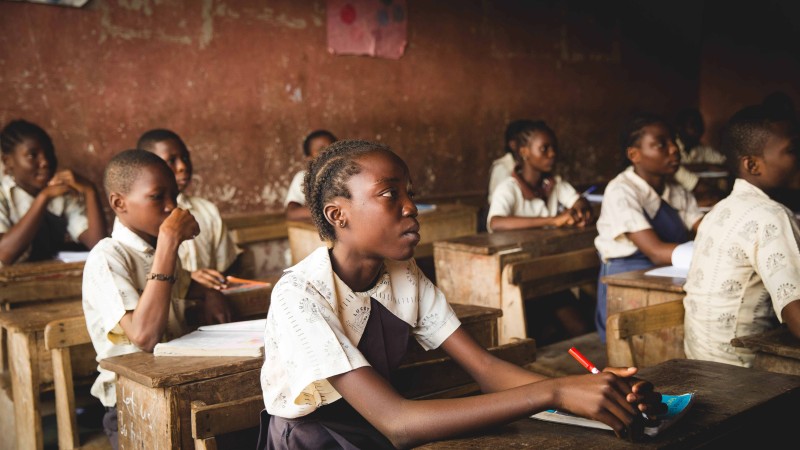
Amina’s story is not unique. It is the lived reality of millions of children across Africa whose futures are being shaped not only by poverty, conflict or geography, but by governance failures that have quietly weakened the continent’s education systems. While governments regularly promise free and quality education, the number of children outside the classroom remains alarmingly high.
According to UNESCO’s Global Education Monitoring Report, more than 98 million children, adolescents and young people in sub-Saharan Africa are out of school, making the region home to the largest education exclusion crisis in the world. This raises an uncomfortable but necessary question: after decades of education reforms, international funding and political commitments, why are so many African children still being denied one of their most basic rights?
No country reflects this contradiction more starkly than Nigeria. According to UNICEF, about 18.3 million Nigerian children are currently out of school, the highest figure recorded globally. Public debate often attributes this crisis to insecurity, poverty, child labour and cultural practices, and while these factors are undeniably important, they do not fully explain the problem.
Behind many empty classrooms lies another challenge that receives far less attention: corruption. Weak governance, poor financial accountability and ineffective public institutions have allowed resources meant for education to disappear long before they reach the children they were intended to serve.
When corruption dominates the news, it is usually associated with stolen public funds, inflated contracts or high-profile political scandals. Education rarely features prominently in those conversations, yet corruption quietly influences almost every aspect of a child’s learning experience. Funds allocated for constructing classrooms are sometimes lost through contract inflation or project abandonment. Procurement processes intended to supply schools with textbooks, furniture and learning materials can be manipulated, leaving pupils to learn in overcrowded classrooms with inadequate resources. Delays in teacher salaries caused by payroll fraud or poor financial management affect morale, increase absenteeism and reduce the quality of instruction. According to the United Nations Office on Drugs and Crime (UNODC), corruption in public service delivery disproportionately harms the poorest citizens by diverting resources away from essential sectors such as education and healthcare, making children from disadvantaged communities the greatest victims of governance failures.
The consequences are visible across much of the continent. In many rural communities, children study under trees because classrooms were never completed. Schools operate without electricity, clean water or functional sanitation facilities. Libraries remain empty, science laboratories lack equipment and teachers often work under extremely difficult conditions. These shortcomings are not always the result of inadequate budgets. More often, they reflect weak accountability systems that fail to ensure public funds reach the schools and communities for which they were intended.
The out-of-school crisis is frequently described as a humanitarian challenge, but it is equally an economic one. The World Bank consistently identifies education as one of the strongest drivers of long-term economic growth, arguing that every additional year of schooling increases future earnings, improves labour productivity and strengthens national economies. Children who leave school early are more likely to experience unemployment, low incomes and persistent poverty throughout adulthood. For Africa, where young people represent one of the continent’s greatest competitive advantages, failing to educate millions of children means undermining future economic growth before it even begins.
African leaders often describe the continent’s youthful population as a demographic dividend capable of driving innovation and development. However, a youthful population becomes an economic advantage only when it is educated, skilled and healthy. Without quality education, today’s out-of-school children risk becoming tomorrow’s unemployed adults, widening inequality and placing greater pressure on already fragile economies. Corruption therefore steals far more than public money. It steals productivity, innovation, entrepreneurship and the future tax revenues that educated citizens would have generated.
It would be inaccurate to blame corruption alone. Across Nigeria, Sudan, Burkina Faso, the Democratic Republic of the Congo and several countries in the Sahel, armed conflict has forced schools to close, displaced teachers and interrupted education for millions of children.
UNICEF continues to warn that attacks on schools remain one of the greatest threats to children’s right to education in conflict-affected regions. Climate change has also intensified the crisis as floods, droughts and extreme weather damage school infrastructure and force families to relocate.
Yet these challenges also reveal an important distinction. Countries with stronger institutions generally respond more effectively to emergencies than those where governance systems remain weak. Strong public institutions can rebuild damaged schools more quickly, ensure emergency education funding reaches affected communities and maintain greater accountability during crises. Weak institutions, by contrast, often compound existing problems through delayed responses, poor coordination and financial leakages.
Recognising the importance of institutional reform, the African Union’s Continental Education Strategy for Africa (CESA 2016–2025) identifies improved governance, accountability and sustainable financing as essential pillars for transforming education across the continent. The strategy acknowledges that increasing education budgets alone is insufficient if financial oversight remains weak and corruption continues to undermine implementation.
Several African countries have demonstrated that progress is possible. Rwanda has invested significantly in teacher development, digital learning and universal basic education, while Botswana continues to allocate a substantial share of public expenditure to education.
Ghana’s Free Senior High School policy has expanded access to secondary education, although debates continue regarding its long-term financing and quality. These experiences suggest that political commitment, transparent public administration and sustained investment can improve educational outcomes when accompanied by strong institutions.
For Africa to reverse the out-of-school crisis, governments must look beyond simply constructing additional classrooms. Education budgets must be managed transparently, procurement systems strengthened, teachers recruited and paid fairly, and communities empowered to monitor how education resources are spent.
Digital budget tracking, electronic payroll systems and open contracting initiatives can reduce opportunities for corruption while improving accountability. Civil society organisations, journalists, parents and local communities also play a crucial role by demanding greater transparency in education spending and ensuring public officials remain accountable.
The greatest resource Africa possesses is not its oil, minerals or agricultural land. It is its people. Every child denied an education represents talent that may never be realised and potential that may never contribute to society. Behind every out-of-school child is a future doctor who may never treat patients, an engineer who may never design infrastructure, a scientist who may never make discoveries or an entrepreneur who may never create jobs. When corruption diverts resources away from classrooms, it does more than weaken education systems; it weakens Africa’s future workforce, its economies and its ability to compete globally.
The out-of-school crisis should therefore be recognised not merely as an education challenge but as one of the continent’s most urgent governance failures. If African governments are serious about achieving sustainable development, they must treat corruption in education with the same urgency as corruption in any other sector.
Ensuring that every education budget reaches the classroom, every teacher receives the support they deserve and every child has access to quality learning is not simply an investment in schools. It is an investment in Africa’s future prosperity, stability and global competitiveness. Until governance improves, millions of children like Amina will continue watching opportunity walk past them every morning, knowing that their greatest obstacle is not a lack of ambition but a system that has failed to protect their right to learn.