






By Livinus Chibuike Vicor
Walk into a Nigerian market, supermarket, roadside shop or even an online marketplace, and there is a good chance that you will encounter products whose authenticity is difficult to determine.
From medicines and cosmetics to food products, beverages, household items and consumer electronics, counterfeit and substandard products have become a serious concern for consumers and regulators.
The disturbing reality is that many consumers may use or consume counterfeit products without knowing it.
This raises an important question: How many fake or substandard products does an average Nigerian come into contact with in a single day?
There is no credible nationwide study establishing that every Nigerian consumes more than ten fake products every day. However, the sheer range of products vulnerable to counterfeiting means that the problem deserves far greater public attention.
The Hidden Counterfeit Economy
Counterfeit products are goods deliberately made or presented to look like genuine products, often using another company’s name, trademark, packaging or branding without authorization.
Substandard products are different but equally concerning. They may be genuine products that fail to meet required quality, safety or performance standards.
In everyday life, the difference may not always be obvious to the consumer.
A person may wake up in the morning and use toothpaste, soap, cosmetics or skincare products. They may take medication, drink bottled water or a beverage, charge a phone with an electrical charger, use household products and purchase food from a shop.
At several points along that chain, the consumer may have to rely on the seller, manufacturer, distributor or regulator to ensure that the product is genuine and safe.
When those safeguards fail, the consumer carries the risk.
Fake Medicines: A Particularly Dangerous Problem
Among all categories of counterfeit products, fake and substandard medicines are especially alarming.
A medicine that contains the wrong ingredient, too little of the active ingredient, a harmful substance or no active ingredient at all can have serious consequences.
The danger is not always immediate.
A patient who takes ineffective medicine may believe that the treatment is working slowly, while an illness continues to develop. In some circumstances, delayed or ineffective treatment can contribute to complications.
This is why medicine regulation is not simply an economic issue. It is also a public-health issue.
Consumers should obtain medicines from legitimate and properly regulated outlets and should be cautious about products sold at unusually low prices or without proper packaging, labelling or regulatory information.
Food and Beverages Are Not Immune
The conversation about counterfeit products often focuses on medicines, but food and beverages also deserve attention.
Consumers can encounter adulterated, improperly packaged, expired, falsely labelled or otherwise unsafe food products.
Some products may be repackaged and sold under misleading descriptions. Others may imitate the packaging of popular brands, making it difficult for an ordinary consumer to distinguish between the genuine and counterfeit versions.
The problem becomes more complicated when consumers purchase products through informal channels where traceability is limited.
For a country with a large population and a vast informal economy, effective monitoring of every point of sale is a significant challenge.
Why Do People Buy Fake Products?
It would be easy to blame consumers, but the situation is more complicated.
Price is one major factor.
When the cost of living rises and people’s purchasing power falls, consumers naturally search for cheaper alternatives.
A person who cannot afford a genuine product may be tempted to purchase a cheaper version, especially when the counterfeit product looks almost identical to the original.
Availability is another factor.
In some markets, consumers may have difficulty finding genuine products from authorized distributors.
Lack of information also plays a role.
Many consumers do not know how to identify counterfeit products.
Sophisticated counterfeiters can reproduce packaging, logos, colours, security labels and other visual features with increasing accuracy.
The Internet Has Changed the Game
The growth of online commerce and social media has created additional opportunities for counterfeit sellers.
A consumer may see a product advertised online, make payment and receive an item that looks different from what was advertised.
The problem is particularly challenging when sellers operate anonymously or use temporary online accounts.
Digital marketplaces therefore face an important responsibility to improve seller verification, product traceability and mechanisms for reporting suspected counterfeit goods.
Consumers also need to exercise caution when buying expensive or safety-sensitive products online.
Counterfeiting Hurts Legitimate Businesses
The victims of counterfeit trade are not only consumers.
Legitimate manufacturers and businesses also suffer.
A company that invests heavily in research, quality control, workers, packaging, distribution and regulatory compliance can find itself competing against someone selling an imitation product at a fraction of the cost.
Counterfeiting can therefore discourage investment and damage legitimate businesses.
It can also reduce government revenue when counterfeit transactions bypass legitimate tax and regulatory systems.
The wider economic consequences can include lost jobs, reduced investment and weakened consumer confidence.
The Role of Nigerian Regulators
Nigeria already has institutions responsible for regulating different categories of products.
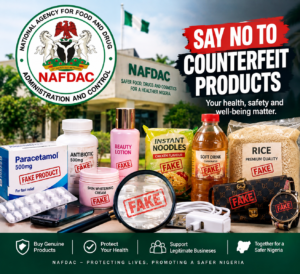
The National Agency for Food and Drug Administration and Control (NAFDAC) plays a major role in regulating food, drugs, cosmetics, medical devices and related products.
The Standards Organisation of Nigeria (SON) is responsible for standards and conformity assessment across numerous product categories.
The Nigeria Customs Service also has an important role in intercepting illicit goods entering the country, while law-enforcement agencies can investigate and prosecute criminal activities associated with counterfeit trade.
The challenge is not simply having institutions on paper.
Effective enforcement requires adequate resources, modern technology, intelligence sharing, border controls, laboratory capacity, consumer awareness and consistent prosecution.
Consumers Also Have a Role
Government cannot fight counterfeit products alone.
Consumers can reduce their risk by buying medicines from legitimate pharmacies and authorized outlets, checking product packaging and expiry dates, paying attention to regulatory information and being cautious about products sold at suspiciously low prices.
Where available, consumers should use official verification systems provided by regulators and manufacturers.
People should also report suspected counterfeit products to the appropriate authorities rather than simply moving to another seller.
A counterfeit product that is rejected by one consumer can still be sold to another person.
The Uncomfortable Question
Nigeria’s counterfeit problem raises a broader question about the country’s consumer culture and regulatory environment.
How did a situation develop in which consumers can sometimes purchase products without knowing with confidence where they came from, who manufactured them or whether they meet safety standards?
And perhaps an even more important question is:
How much counterfeit or substandard material passes through the hands of an average Nigerian before the day is over?
There is currently no credible evidence to support the sweeping claim that every Nigerian consumes more than ten fake products every day.
But the absence of such a statistic should not distract from the underlying problem.
The counterfeit economy is real, and its consequences can range from financial loss to serious health and safety risks.
Beyond Raids and Seizures
Occasional raids and seizures may attract headlines, but the long-term solution requires more than enforcement operations.
Nigeria needs stronger product traceability, better consumer education, improved border controls, stronger collaboration between regulators and manufacturers, effective digital monitoring and meaningful consequences for businesses deliberately involved in counterfeit trade.
Manufacturers can also help by making authentication easier for consumers through secure verification technologies.
Retailers and distributors should maintain proper records showing where their products come from.
Consumers, meanwhile, should understand that an unusually cheap product may sometimes carry a hidden cost.
A Shared Responsibility
The fight against fake products is ultimately a shared responsibility.
Government must regulate and enforce.
Manufacturers must protect their supply chains and educate consumers.
Retailers must sell responsibly.
Online platforms must strengthen their systems.
And consumers must remain vigilant.
The goal should not simply be to protect famous brands.
It should be to protect human lives, legitimate businesses, public health and consumer confidence.
Nigeria is too large, and its economy too important, to allow counterfeit products to become an accepted part of everyday life.
The real challenge is not determining whether Nigerians consume ten fake products a day.
The real challenge is making sure that when a Nigerian buys a product, they can trust that what is written on the package is actually what is inside it.